

Hello,
You probably forgot this newsletter existed – I certainly did! Since it wound down I’ve been continuing to work on stuff around the political economy of logistics, but I haven’t been doing it alone. Over the past 18 months or so, I’ve been working with Miriam Matthiessen. We met through the Abandoned Seafarer Map project, and have been texting each other about marine insurance since.

We’re now a research-arts duo, called Liquid Time. We’ve been writing and making video work around shipping, finance, and the temporalities of maritime worlds. This newsletter is now going to become the Liquid Time substack. It will be a blend of logistics news, takes, and experiments.
It’s a bit old now, but a quick way to get a sense of what we’re thinking about is this piece we wrote last year for Weird Economies, about how container shipping is, well, weird.
Notes on Houthis
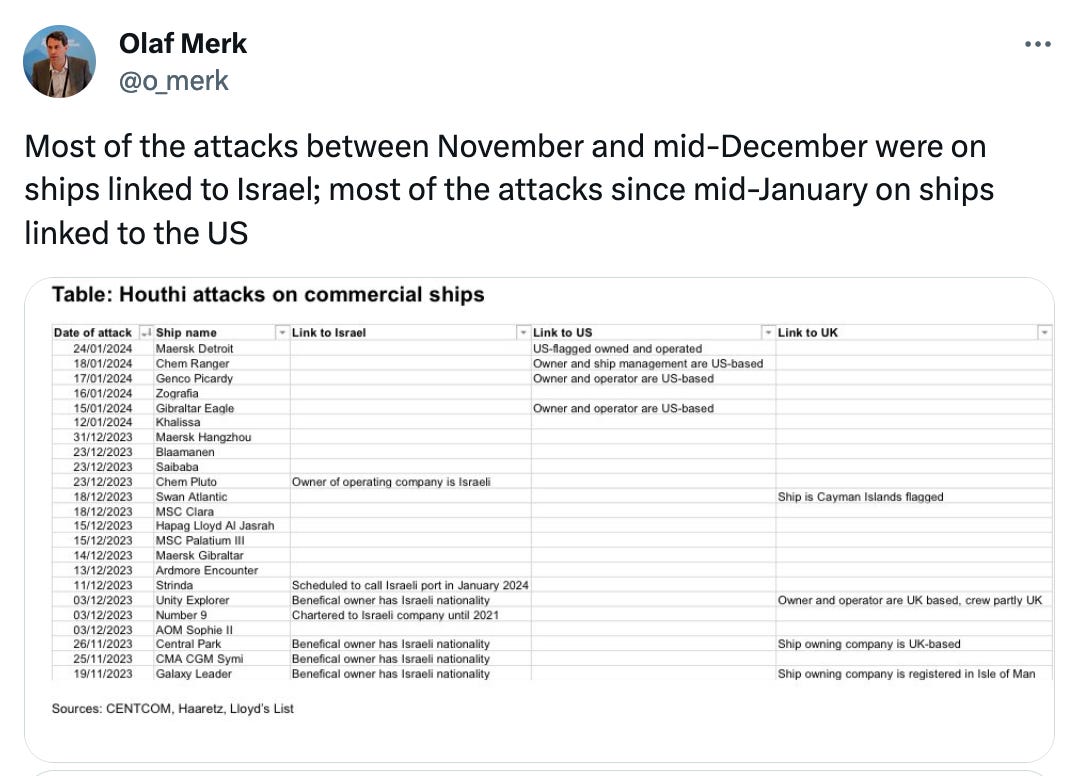
The big story in shipping right now is, obviously, the attacks on ships passing through the Red Sea, in solidarity with the people of Palestine. Olaf Merk from the ITF has been keeping a spreadsheet of the attacks, and noted that all were indeed on ships with some connection to Israel. After the US and UK started attacking Yemen, US-affiliated ships also became targets.
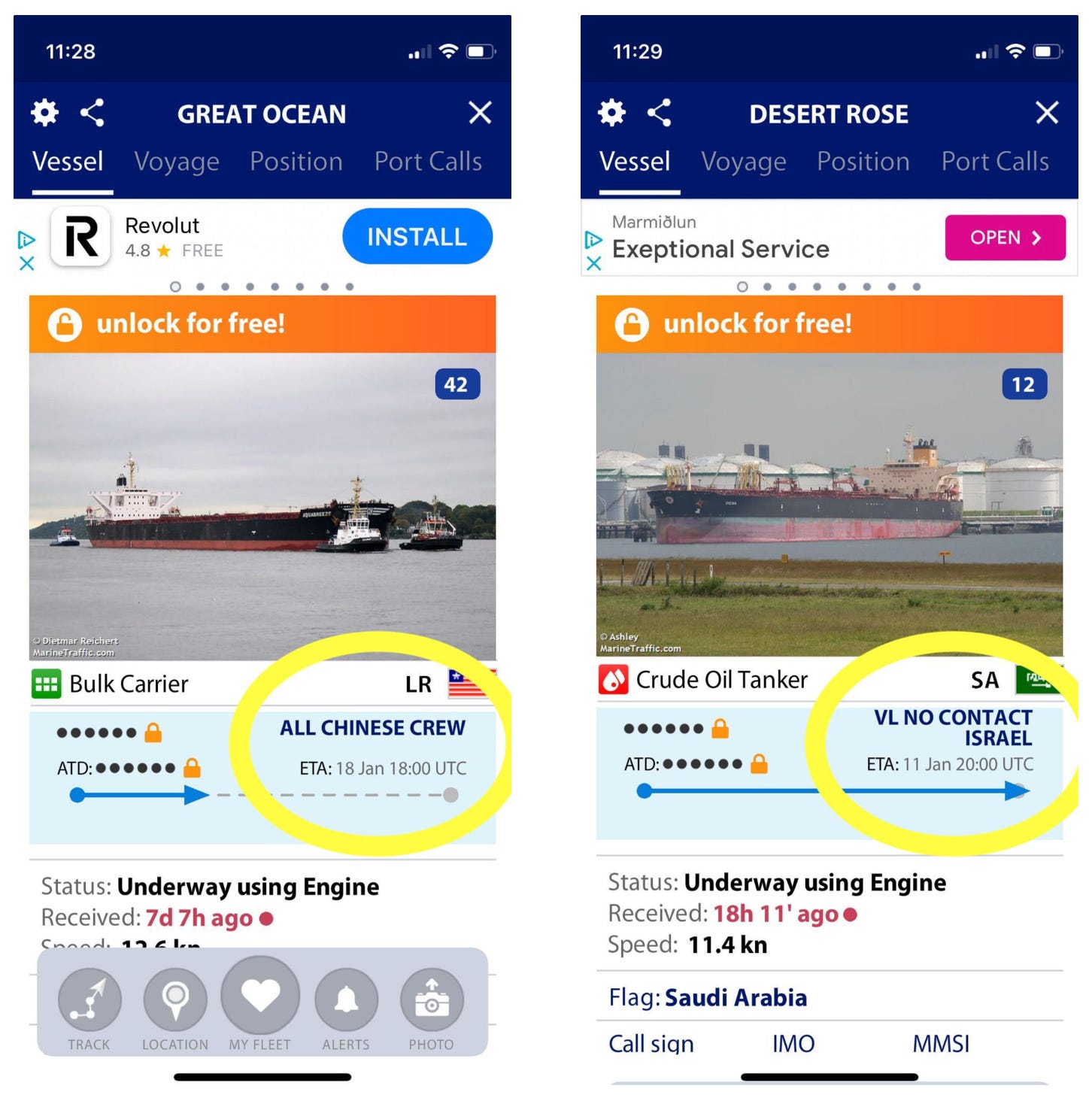
One thing that people on Twitter have been noticing is that ships have been using the ‘Destination’ input field on their public AIS broadcast (basically a ship’s location transmitter) in order to communicate a lack of affiliation with US or Israel. Miriam grabbed these screenshots from Marinetraffic.com.
Insurance premiums for passing through the Red Sea (and beyond it, the Suez canal – a key gateway between Europe and Asia) are spiking due to war risks. This is pushing carriers to reroute cargo around Africa, increasing journey times (and fuel costs). But there’s another crucial factor within this. In our piece for Weird Economies, we wrote about how the container shipping industry has been facing oversupply issues, dubbed the ‘overcapacity crisis’: too many ships have been built, that can carry too many containers, which would potentially put an end to the pandemic-initiated era of inflated prices and resultant record dividends for shareholders. To keep the price buoyed up, shipping companies have to push supply down. As a container shipping company, there are multiple ways that you can reduce your carrying capacity. You can sell your ships (although you’d struggle to find a buyer), you can simply destroy them (at a place like this), or you can find ways to slow your entire system down, so that everything takes longer and demand is maintained.
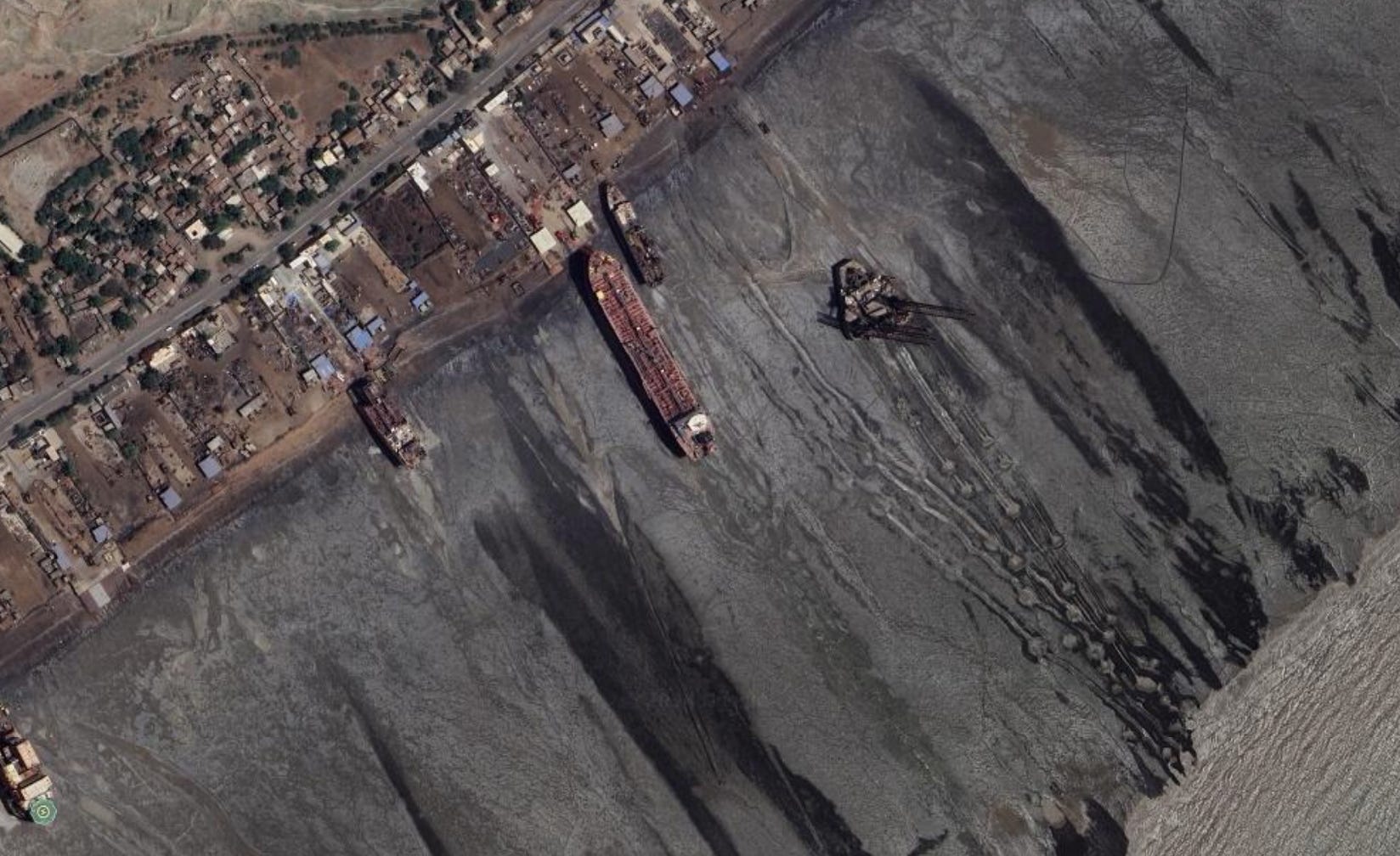
Anang Shipbreaking Yard, Gujarat, India, where you might destroy a ship.
Having to reroute ships away from the Red Sea / Suez Canal and around Africa is having this effect. Although the attacks are taking their toll on some American companies, for the carriers themselves it’s a different story. The stock price of Zim – Israel’s largest carrier – has actually been creeping back up since the attacks began. We kind of hate to see it, but there are ways that for some of the big players, the Houthi attacks a blessing in disguise.
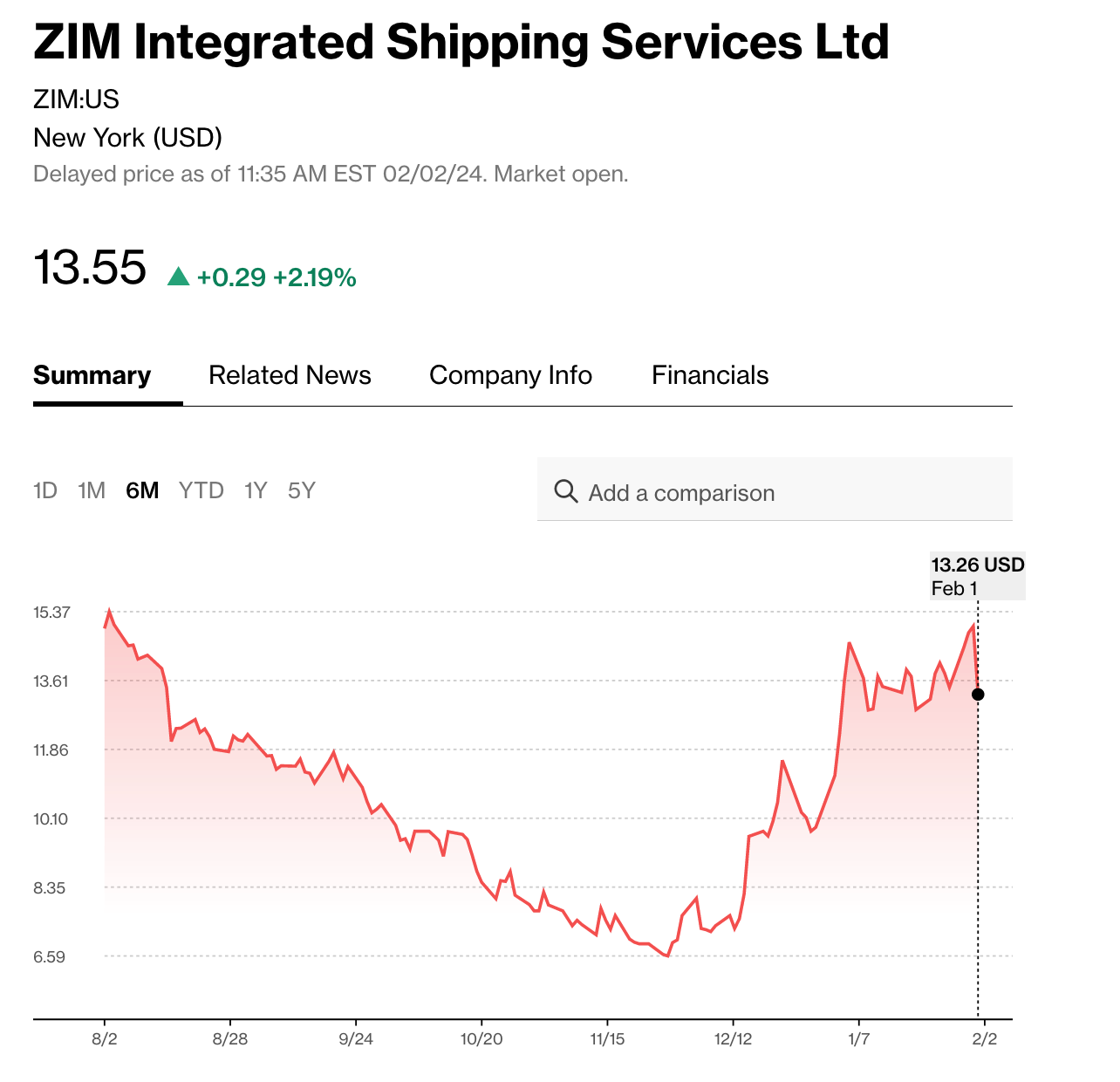
Source: Bloomberg. The first Houthi ship seizure took place 19 November.
This points to something Martin Danyluk wrote about last year, on how disrupting flows of commodities at choke points does not always translate into effective pressure on multinational corporations supporting various atrocities worldwide. The fact that money can be made not just from the speeding up of getting things from A to B but also from the slowing down also points to how supply chains have adapted into a particular kind of resilience – not resilience in the sense of ‘we will get you your shoes in 5 days no matter what’, but resilience as in regardless of whether things are shipped quick or slow, the big players get paid.
What We’ll be Thinking About and How We’ll Think About It
We study logistical systems because we think they are the best way to understand counterintuitive movements in global political economy, geopolitics and labour struggles. We focus on maritime trade systems, because that’s the main way commodities move. We approach logistics as a project of time management: an expanded process of configuring, distributing and expropriating planetary time – both present and future.
Logistical infrastructures are global capital’s nervous system. They are not just passive enablers of trade, of getting goods to market. They are active agents in making, shaping, reshaping those markets, of determining what commodities will flow and how they will do it. These infrastructures – mega-ports, container ships, and the millions of people that work to keep them running – carry with them a forward motion, an inertia that keeps the wheels of accumulation turning.
Logistics would seem to be about enabling present markets to function, but every port expanded, every megaship built, every shipping lane securitised is at once a bet and an assurance on a particular version of the future. Logistical planning, in this sense, mirrors the temporal acrobatics of finance: the present is produced through anticipation around competing futures.
We are interested in the interplay between prediction and production, between forecasting and manifesting. We want to understand how logistical infrastructures don’t just enable particular economies to function in the present, but work to produce and normalise particular futures. The futures that logistics produces are often just continuations, updates, patches on an untenable and violently accumulative present.
Stay Tuned, and tell your friends!
Jacob and Miriam